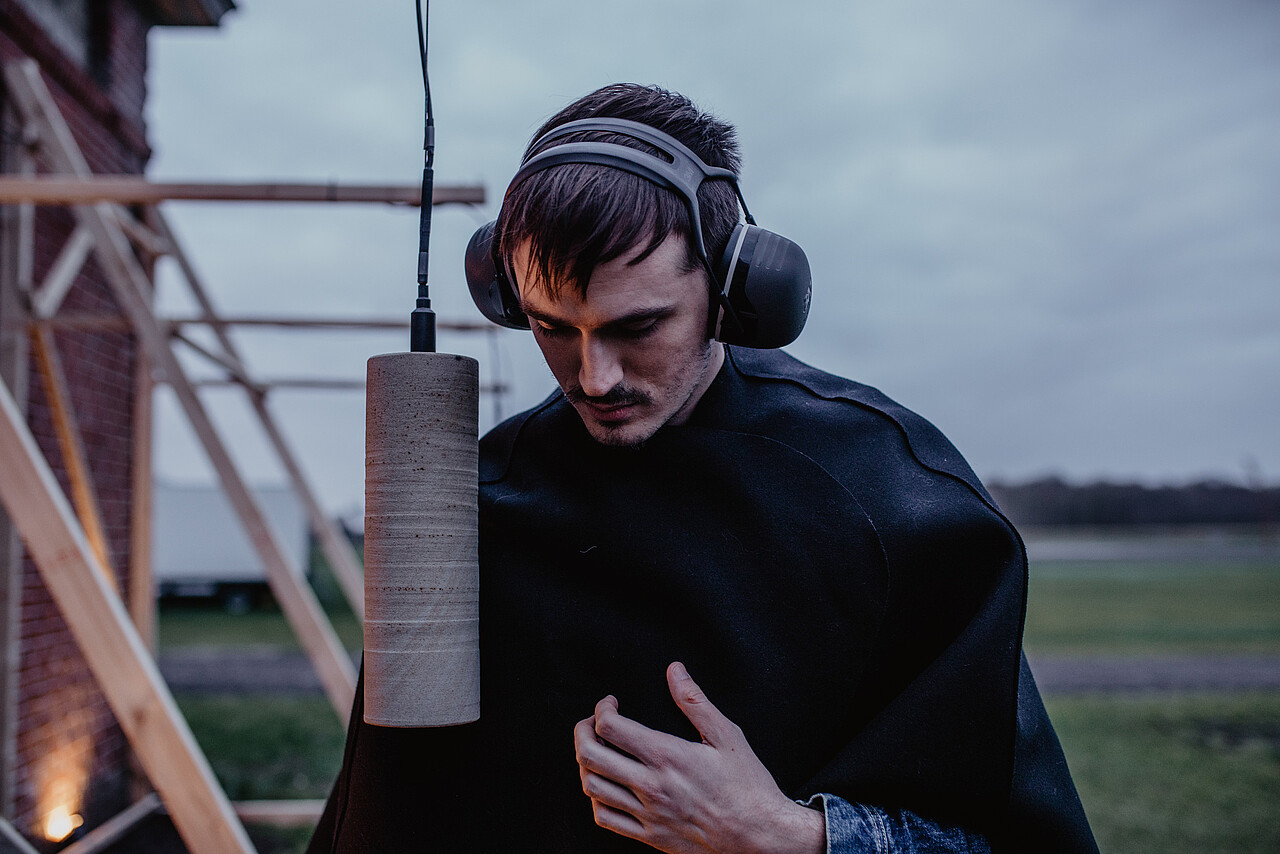
The Intimate Earthquake Archive re-situates earthquakes within the bodies of the visitors as different vibrational compositions.
Over the last four decades, citizens in the north of The Netherlands have experienced man-made earthquakes due to gas extraction in the largest field for natural gas in Europe – the Groningen Gas Field. »The Intimate Earthquake Archive« brings together two different sources of information about man-made earthquakes: official records of seismic activity via the Dutch Meteorological Institute (KNMI), and the personal stories and felt experiences of local residents.
The artists have carefully chosen 12 earthquakes of cultural and political significance in the region to be part of this sensory archive, working to transform these datasets into vibratory compositions that move across the skin, through the viscera and skeleton. Visitors explore this archive by wearing vests embedded with body and bone transducers. They trigger the different earthquake compositions by walking within the archive and positioning themselves among its network of long-wave radio transmitting core samples, each representing one of the 12 earthquakes. The vibrations move across the skin similarly to how the earthquakes moved across the land, to inspire a deep listening experience within the body. With each earthquake composition, it is as if one is opening an archive drawer and pulling out the historical record, examining it through one's skin, flesh, and bone.
Through embodied attunement, the work asks how manmade geological changes might be recorded and experienced, what kind of impact resource extraction can have on human and geological scales, and how this is recorded into history. In the current context of Russia’s full-scale invasion of Ukraine, it also alludes to questions around energy independence via increased efforts around domestic extraction of non-renewable fuels.
Concept and Research: Sissel Marie Tonn
Composition and Data Sonification: Jonathan Reus
Interactive system and software/hardware development: Marije Baalman, Carsten Tonn-Petersen, Jonathan Reus
Wearable design for iteration 3: in collaboration with Das Leben Am Haverkamp
With structural support from: Stichting Niemeijer Fonds, TNO, KNMI, Stroom Den Haag, Augmented Instruments Laboratory - Centre for Digital Music, iii.
The presentation at CTM 2026 is supported by the Embassy of the Kingdom of the Netherlands.
CTM 2026 Exhibition
24.1. – 22.3.2026 | Free entry
daadgalerie & Kunstraum Kreuzberg