Political Sonic Practices
Stas Sharifullin, Hanna Grześkiewicz, Nico Daleman. Host: Anita Jóri
00:00
silent greenWatch on YouTubeWatch on YouTube
RND 2023 will assemble nine students, scholars, and artists/researchers from a variety of fields of study and approaches who will present research touching on the Portals theme. The selected candidates will give short presentations (10 min.) within different thematic modules, with short discussions after each presentation and at the end of each session. RND will take place as a hybrid in-person and streamed event and is offered free of charge. Presentations will be in English.
Welcome
In a short welcome word, Anita Jóri introduces CTM 2023's Portals theme and the day's three modules that address the topic from a variety of perspectives. The sessions will take place in-person at the Kuppelhalle within silent green, and will also be streamed live over CTM’s YouTube channel. Virtual audience members are invited to send questions via the YouTube chat. These will be discussed at the end of each module together with the presenters and host.
Becoming-Resonant: On the Political Potential of Indigenous Sonic Practices in »the Prison of the Nations«
Stas Sharifullin (Universität Basel & UdK Universität der Künste Berlin, INT)
Khöömii singing, epic poems, such as olonkho and kubair, the traditions of manufacturing and playing quray [as well as many other sonic practices of Russia’s indigenous peoples] have been carefully preserved under the centuries of oppression—from the early tsarist settler colonialism, aggressive military expansionism, and multiple uprisings that were brutally suppressed to communists’ quasi-decolonial experiment and beyond. Focused on the intersubjective experience between human and sound, some of these practices tend to transform the performer’s body into a non-static, transcorporeal sonic object (hence the Deleuzian »becoming«), which is revealed differently under the different listening positionalities. In contrast to the Western dissection between a composer and a performer, some of these »exercises in de-alienation« are inseparable from the artists’ bodies and minds. Deeply rooted in tradition, they also tend to substantially challenge the keystones of the current music/arts industry—the notions of ego, domination, and power.
Stas Sharifullin (ul / unıñ) is a Bashkir/Russian, Siberian-born researcher and artist working with sound and contexts of the sonic. Currently ul is an Associate Researcher at the Critical Media Lab, a Medienwissenschaft PhD student at the University of Basel, and guest lecturer at the Sonic Studies and Sonic Arts M.A. at Berlin University of the Arts. Unıñ research examines the potential of sonic agency, e.g. how sound and music operate in contexts of sociopolitical / decolonial activism and resistance practices, addressing the variation in inequality across authoritarian regimes and unbalanced power dynamics under late capitalism.
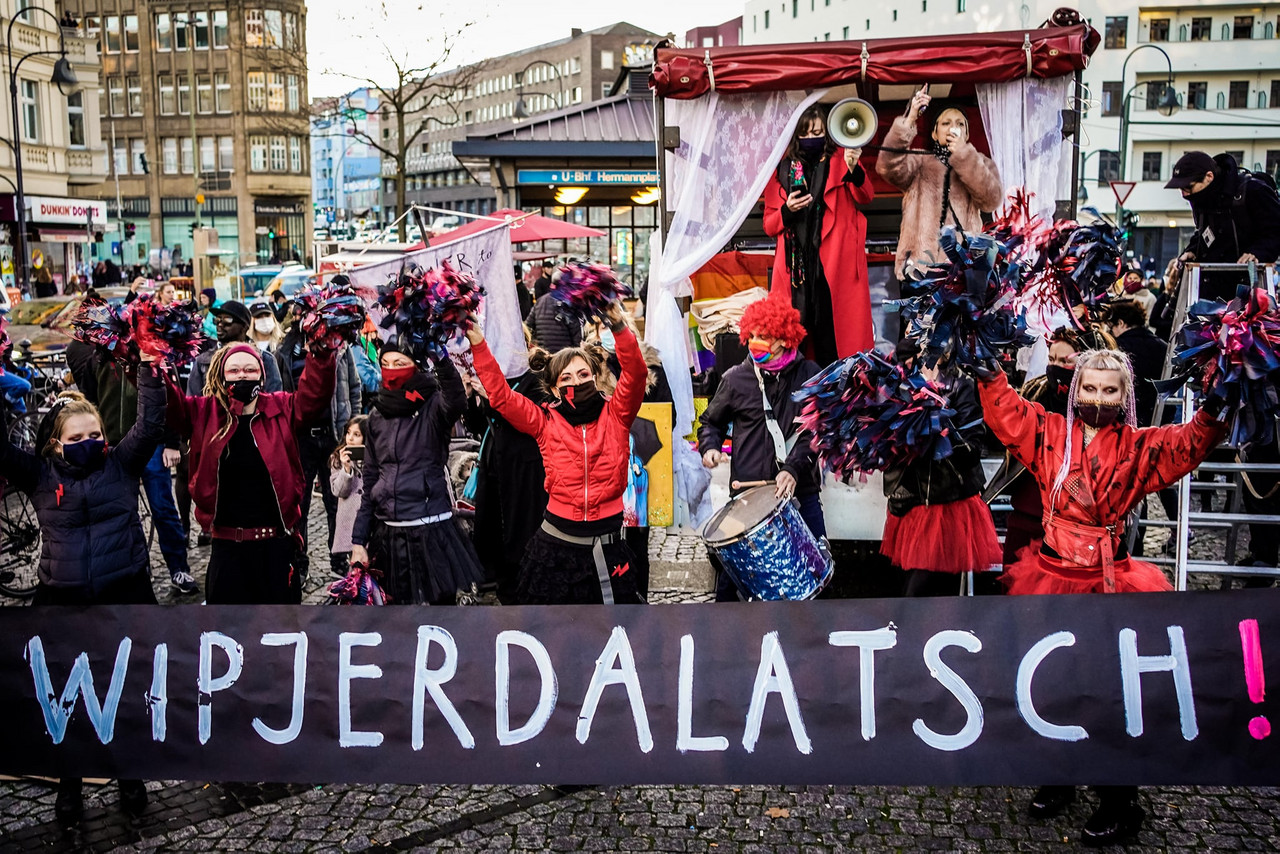
Sounds of Resistance – Polish Women’s Strike 2020/21
Hanna Grześkiewicz (independent curator and researcher, PL)
How do social movements sound? (How) can you use sound to affect change? What is the relationship between the artist and the activist when bodies meet in the streets? This presentation explores sound as a form of resistance, using the 2020/21 Polish Women’s Strike protests as a case study.
When the Polish Constitutional Tribunal voted on a de facto abortion ban on 22 October 2020, hundreds of thousands of people took to the streets across the entire country – making this one of the most visible and socially broad protest movements in Poland’s recent history. In the study of social movements, sound is often neglected, with the visual dominating the digitised-mediatised news cycle. Sound is, however, a huge and deliberate aspect of planning demonstrations. Artistic and sonic interventions played an important role in this movement – such as the famous repurposing of Erik Prydz’s dance classic »Call On Me« with the chant »J**** PiS / F*** PiS«. The affective power of sound has the potential to bring communities together (Lynne Segal) through the creation of collective memory as well as offering a rendering of the moods and ideologies permeating through the movement in real-time.
This presentation explores the limits and potentials of sonic agency, the fluid line between artist and activist, the (utopic) sonic fictions created during a protest, and what the resonances of social movements can tell us about the effects (and affects) of taking up public space – particularly by those who are often excluded from these spaces.
Hanna Grześkiewicz is a curator, researcher, writer, and activist within several feminist and migrant groups in Berlin. She is part of transmediale 2022’s Research Group and her research is currently focused on the relationship between the arts and social movements. She has degrees from the University of Cambridge and Humboldt University in Berlin. Hanna sits on the board of the Berliner Gesellschaft für Neue Musik and co-creates a radio show morning stories on Warsaw’s Radio Kapitał. She writes regularly about music and sound for Positionen, and about political themes related to Eastern Europe and feminism. She has written for Arts of the Working Class, Rosa Luxemburg Foundation, openDemocracy, and jungeWelt, among others.
Tropicanibal migrations. Cumbia a sonic safe space for Latin-American migrant communities?
Nico Daleman (independent artist and researcher, CO/DE)
Cumbia as an umbrella term for Afro-Caribbean Colombian music, has been gaining popularity in the global music scene in recent years. Its rise served as a unifying force for Latin-American migrant communities in northern Europe, while creating an imaginary of sophisticated Tropicalia tailored to the tastes of the global markets. Nevertheless, a deeper look reveals a more nuanced relationship between race, class, and regional dynamics of Colombian and Latin-American society.
Borrowing the concept of »Macondism« from the literary studies, I explore the dynamics of romantization and commodification of Caribbean culture while considering the processes of regional, cultural, and class appropriation. Tropicanibal migrations associates Pan-American relocations of cumbia and the languages of European experimental electronic music, finding associations between their itinerant musical characteristics and their cultural global contexts. Through pragmatic creolization cumbia transcends musical stereotypes and challenges the hegemonic binaries between pop and art music, kitsch and good taste, urban and folk, global north and south. My project askes in which ways is tropical music reappropriated and turned into a symbol of hipness and sophistication in the imaginaries of non-Colombian markets? Is this new interest in Afro-Caribbean an opportunity for new genuine musical languages that avoid previously imposed clichés, or is this a renaissance of »World Music« disguised as postcolonialism?
Nico Daleman is a Colombian-born musicologist, researcher, and sound artist based in Berlin. He explores contemporary music, musical creativity, and the hybridity between musical genre and music technologies. His writings have been published in MusikTexte, Positionen, and the Berliner Festspiele Blog, and his research has been presented in conferences such as in the Harvard Graduate Forum 2022, Digital Libraries for Musicology 2021, and Sound of Sound Studies 2021. He is the host of The Rest is Music, a monthly show on Cashmere Radio that explores practices of contemporary music and experimental electronic music on the periphery of the canon. He studied Audio Engineering, Musicology, and Sound Studies & Sonic Arts in Bogotá, Boston, and Berlin.
Event Access
Please consult our Accessibility section for information on volume / lighting, mobility, age restrictions and other access information.