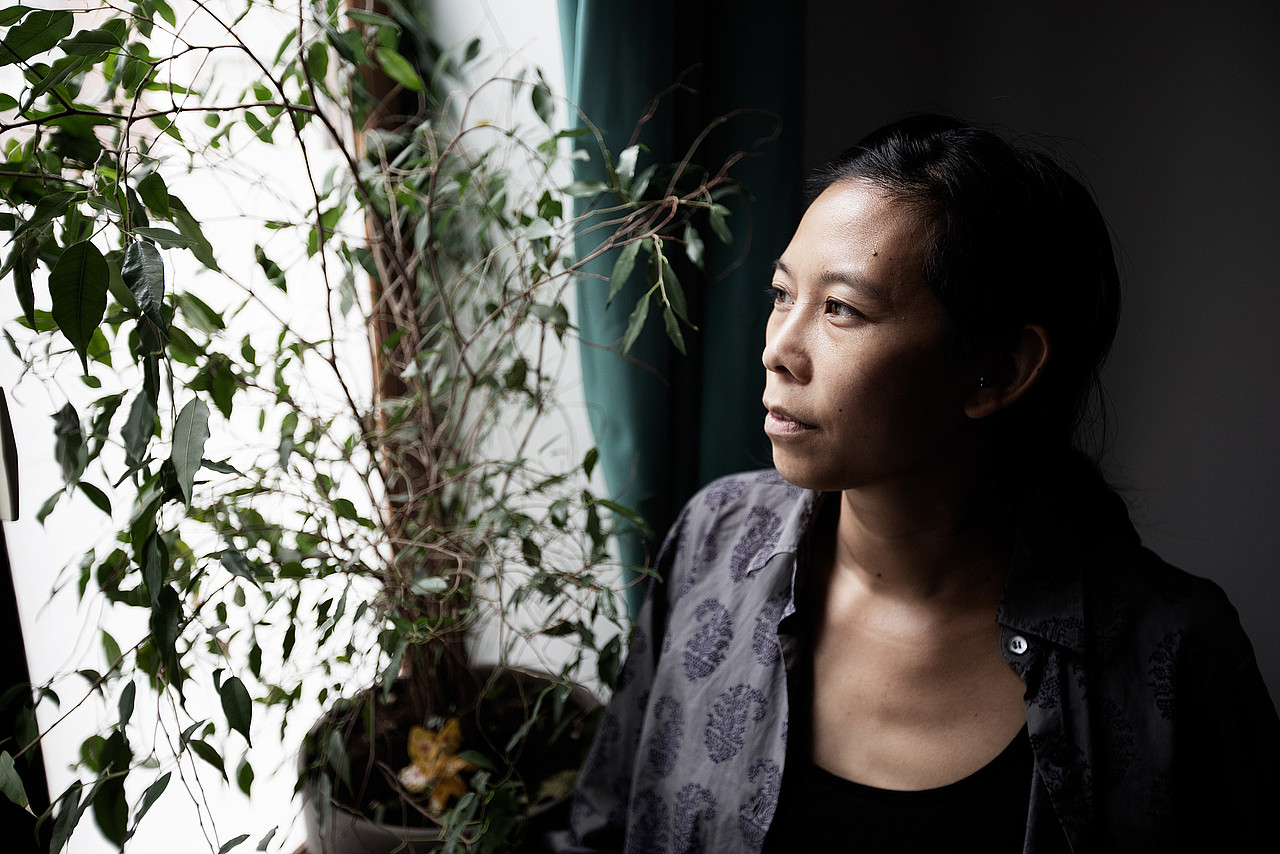
Lau's solo efforts were documented among others on the recording BOOKS (2015), a wooden object trilogy released on the Silent Water label. The album explores the world of synthesizers, samplers, and electronics, as well as the harmonics and metallic basses of various toy pianos, to end up inside of the interior of a prepared grand piano. Her recent album, Trudge Lightly (2020) saw her pair up with bassist Darin Gray to develop over wide structural strings, elegantly combining free improvisation with the material suggestions of electro acoustic experimentation. 2021 will see several releases, including one by her 6-piece ensemble piece Bakunawa.
Lau's collaborations veer into different directions, from deep grooves (via Going) and abstract texturing (projects lauroshilau, and Duo Pour 454 Chordes) into crossmedia projects with photographers (Stills) and shadow theatre (Le Poisson et La Perle/ The Fabulous Choi Sisters). She has composed music for dance theatre, short movies, sound walks, and documentaries. As an improviser she has shared music with Chris Corsano, Akira Sakata, Darin Gray, Tatsuhisa Yamamoto, Tetuzi Akiyama, Mette Rasmussen, Rie Nakajima, Toshimaru Nakamura, Susana Santos Silva, Manuel Mota, Paolo Angeli and many more. Lau has toured different festivals and venues in Europe, UK, Taiwan, Hong Kong, and Japan.
CTM 2022 xSHAPE mix: Pak Yan Lau by CTM Festival
CTM 2022 xSHAPE mix: Pak Yan Lau by CTM Festival
Live at KANAL Centre Pompidou, Brussels - Pak Yan Lau
Yoru - Pak Yan Lau
»The first track is a live concert I did on Charlemagne's Palestine carillon as part of an exhibition called It Never Ends, held November 2020. The audience could listen from outside (no inside audience due to Covid), it was amplified and speakers were put on the rooftop of the building. It was an amazing experience playing a carillon for the first time. Since then I have always wanted to do something with this recording. As I will transform it for a next album, I decided to leave this recording pure and live in this mix. A memory of what it was, so in the future we can hear what it has become.«
»The second track is specially conceived for the CTM x SHAPE mix. Lately I have been busy with ceramics (among other things) and recently I made a ceramic wokalimba – a metal object with spikes soldered inside, first designed by Giovanni Di Domenico. It sounds fantastic and is something in between a wok and a kalimba. Instead of metal, I made one completely out of ceramics. This track is played solely on the ceramic wokalimba and processed through different effects pedals. I premiered the ceramic wokalimba during this year's schiev festival in front of a live audience.«
In this short interview, music journalist Lisa Blanning speaks to Pak Yan Lau about her artistic process.
Lisa Blanning: For me, your mix came out at the right time, providing a moment of pensive calm yet hopeful energy during violent, confusing times. How important do you think the emotional element of your music is versus the musical element versus the attempt for something new, creative, different?
Pak Yan Lau: I feel the emotional element and the musical element are very much intertwined in my music. In this way, I don’t really give much importance to it, because it is obviously always present. I think music can tell you a lot about a person. And in my case it is pretty true. I am pretty much how I play. I don’t think I am very much looking for something new or different – it is more a natural flow of what my life or encounters bring. I am a curious being, so I won’t say no to trying a new thing or to a new collaboration, if it feels right. There is not really a drive in me to have to be innovative. So much has been done and tried already by so many great people and artists. But if something feels worth it for me to explore, even if it has been done by somebody else already, I will still do it, because it will be new to me. For instance, prior to the concert you hear on this mix of the carillon, I had never played a carillon. I have a piano background, so I could imagine something, but it is a completely different thing, a whole other instrument. I loved it. The sound, the physicality, the way it envelops you… that was all new and super exciting to me.
LB: I love how much the two pieces in the mix complement each other – carillon bell and ceramic tonalities evoking gamelan. What attracts you so much to this sound? The gamelan motif shows up a lot in your work, I noticed. Do you think you have a fondness for percussiveness from your history with the piano?
PYL: I am very attracted to resonance. I can’t really tell you why exactly, but the resonance and overtones that are produced on metal, bronze, and brass percussive objects or instruments are very rich. I am always amazed by how broad a sound can be in one tone and how that can change depending on the acoustic environment or with the addition of electronics. It is a very natural phenomena, and yet when you listen carefully it is mind blowing. Having my head in the resonance (for instance when I play prepared piano and my head is literally inside the piano) is like a super soothing and trancelike thing. It is true that since I play with the toy piano, I get a lot of these weird gamelan-tinted sounds. A drummer friend once told me that he thought I secretly wanted to be a drummer. And maybe he has a point. The thing is, I love percussion and rhythm, but I really am not so good at it. Maybe this is the way for me to express that love.
LB: As someone who had studied conservatory classical piano, and started at a young age, once you realised that wasn’t for you, how long did it take you to find your voice as an artist? How would you describe that journey?
PYL: I loved playing the piano when I was a kid. The struggle started after a few years in the conservatory. I had a problem with the conserving part of the conservatory, and now looking back, I wouldn’t say all was that bad. I learned a lot and technically benefited from it. Right after the conservatory, I moved to Brussels. That was a turning point for me. I was still traumatized by the grand piano, so I guess that’s the reason I started playing toy pianos. I started to let go of what I thought was expected from me. I discovered improvisation, I discovered synthesizers and electronics. I discovered that you could make music with whatever objects, as long you hear it. I met wonderful, open-minded musicians. Slowly, I took back the grand piano, but was completely into using it as a huge resonating box. I started to travel with my music and started to meet more interesting and different musicians. All this voiced my sound, and now, after almost 15 years, I feel I have come to a point where I’ve slowly started to trust myself and believe that what I hear is ok.
LB: Do you think of your music as connecting with others or with yourself?
PYL: I see music as a universal web. So it is at the same time as connected to yourself as to the others you play with, and to the audience. Since we are emotional beings, we try to communicate with each other. And I believe music is the most direct form of communication. The important thing for me while playing music is that I can find myself in that state of being that is linked to that universal web.
LB: It sounds like you’ve got a talent for ceramics (I read an interview where you mentioned your friends have encouraged you to sell your vases and jars because of their beauty). Do you think there’s any relation to the way you approach ceramics as the way you make music?
PYL: Funny, I started ceramics with the idea that nothing has to happen with it. It was almost therapeutic: no expectations, no deadlines, no stress. If something didn’t go straight, I would just keep it crooked and accentuate that »wrongness.« Nothing I make is straight, by the way. And I don’t care. It has never been my purpose to make perfect round objects, I was interested in what you could do with something that is not quite right. I have to say that I’m more demanding of myself when music is concerned. But now that you put the two together, I have to admit that there are a few similarities. I work with what comes my way. And I don’t know if it’s because I improvise a lot, but I will work with what there is. If there is a broken piano, I will play it and try to take out its essence and beauty.
LB: You’re teaching children – work you call both rewarding and challenging. How do you think the generation/age group you are working with think about music? They must be really tech-savvy and early adopters of applications/digital instruments. How do you think this influences their creativity and ideas about the future/possibilities in music?
PYL: The children I work with are 9–12 years old. I must say I work with a very nice association called Musica, Impuls Centre. They are very unique, because they are interested in both the past AND the future. We experiment quite a lot. To give an example: we are now working with jack cables, an amplifier, effects, and a neon light. The children use the jack to make a buzzing/humming sound. They also discover that their bodies can be connected to the circuit, and by holding each other they can make noise and rhythms all together. On another occasion they get an iPad and have to go out and record sounds in a sampler/app, and we use this to create a composition afterwards. Once, we also simply played with 12 different radios (Cage’s Imaginary Landscape No. 4 for 12 Radios).
What I see is that children have pre-conceptions of what music should be (mainly mainstream music), but they do consider what I offer (mainly sounds and experimentations) and add that into their box of what music could be. Even if not all agree, I feel they are open to it. And by having them experience it, it can leave an impact. The generation that is growing up now is very visual and screen/tech focused. In the end, a lot depends on the individual. You can be very creative with technology, as well. I think what is important is to teach them how to think outside the box, talk about what music is or can be. That is why I think it is important to have organisations like Musica, Impuls Centre.
Supported by the SHAPE platform, which is co-funded by the Creative Europe programme of the European Union. Media partner: Borshch.
