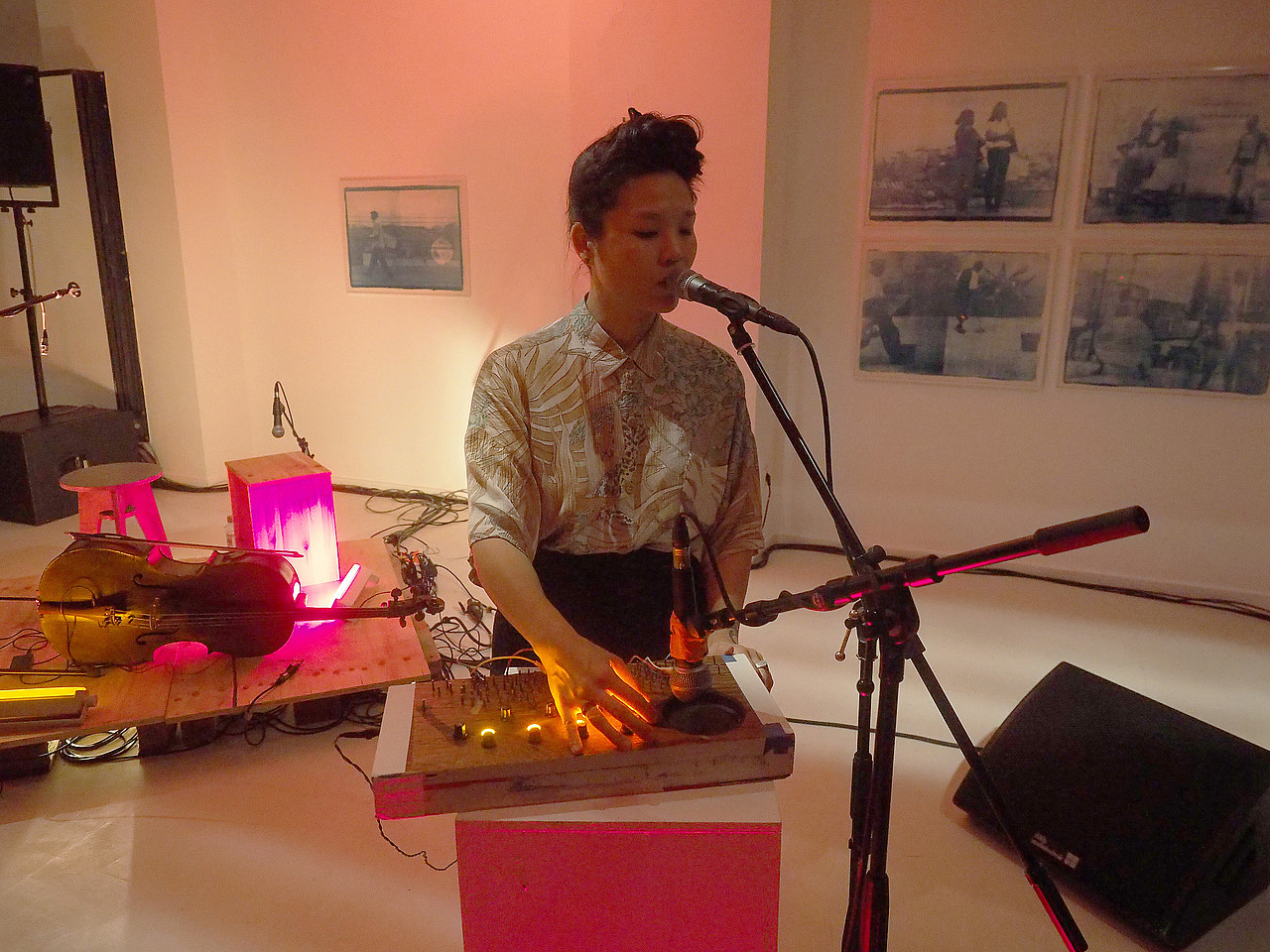
More recently, Chen has begun to shift back towards the exploration of the voice as a primary instrument, delving deeply into her own version of narrative and non-linear storytelling. Writing for The Wire, Julien Cowlez describes her practice as »uncompromising and idiosyncratic music, tightly disciplined yet acoustically wild and heavy with implication. Her ultra-verbal vocalising, often reminiscent of the visceral and emotionally charged sound poetry of François Dufréne or Henri Chopin, exposes physiological aspects of utterance that are concealed within standardised articulation and day to day speech. Fleshy, breath-driven and flecked with spittle, Chen's voice emanates not just from her mouth but from an ensemble of upper body surfaces, channels, passages, and cavities.«
US-born but currently based in Berlin, she has performed widely across Europe, Russia, North/South America, and Asia.
CTM 2022 x SHAPE mix: Audrey Chen by CTM Festival
CTM 2022 x SHAPE mix: Audrey Chen by CTM Festival
01. Audrey Chen & Phil Minton (voices)
02. Audrey Chen solo (voice, cello, electronics)
03. Audrey Chen & Hugo Esquinca (voice & digital process)
borshch is a magazine for electronic music on and beyond the dancefloor. Founded in Berlin in 2017 by Mariana Berezovska and Tiago Biscaia, it’s a space to provoke open dialogues and challenge established ideas about making, listening, and dancing to music. In this short interview, Mariana Berezovska speaks to Audrey Chen about her artistic practice.
Mariana Berezovska: You’ve been involved with music since an early age, and there’s been a few significant turning points on your creative path. The path that embraced transformation, choices, and changing environments. In 2003, you took a new approach to music and experimentation. You’ve mentioned that you rethought »what was beautiful and what was ugly« in music and started thinking beyond the binary and trying to understand social conditioning in music and aesthetics during this period. What was your process with music before that? And could you name a few ideas about playing and listening to music that made you change your direction and allowed more freedom in your process?
Audrey Chen: Before having my son in 2000, I was almost entirely involved in »classical« music study for voice and cello. This event upended my life and paved the way for this change of direction, which was less an aesthetic shift but more of an ideological and existential one. Since I began both instruments at an early age and most of my preoccupation in these earlier years was the perfection of technique, I didn’t yet have the chance to understand more deeply why I was doing it. I gave birth at the age of 23, just on the cusp of adulthood, so this transition became even more amplified by young motherhood and having to care for another human being.
I suppose I was searching all along for a way to synthesize my ideas and find a way to express myself with a more honest and personal approach. Growing up in an immigrant family and as a minority, I felt excluded from the systems that seemed more well suited to the kids from white American families. In school, I was mostly misunderstood, and most kids treated me as an outlier. I found in music a way to focus and a reason to isolate myself out of choice rather than exclusion. I realised the more I practiced and the more deftly I could navigate the instruments, that the ever-growing sound world I could create became its own world that I could find comfort in.
As I grew older and more self-aware, I also began to feel dissatisfied with interpreting other people’s music. The confines of traditional music became too restricted for me. The questions started to creep in. Why is this right? Is it wrong? Is it beautiful? Is it ugly?.. These denominations seemed too haphazard to me. I wondered why I had to listen to all these people who seemed so self-righteous and were nothing like me. Most of the music I had played was composed by white men from totally different backgrounds than me, and most of my teachers were the same. At some point, I had to ask myself: why was I making music that had nothing to do with my own life and how I was choosing to live it? And what value did it have?
In 1999 I found myself pregnant. I was terrified but also filled with a kind of excitement for something new and full of value. The process shifted. My son was born in July 2000, the millenium dragon year, and I was soon deep in postpartum throes, breastfeeding, sleeplessness, and endless diapers. My sense of time also changed as having young children slows everything down to the moment by moment means of their needs. I had to pause my instrumental practices to care for the greater needs at hand, and I was face to face with this little boy who stretched every moment into an endless continuation of himself.
And we spent much of this time, when not attending to his inevitables, in a sparring dialogue of vocal sounds. We were improvising together, and this process influenced how I could begin to see a new way of moving forward with my practice. I also met some people from the local experimental music scene in Baltimore, MD, where I was living at the time. They introduced this idea of using improvisation to experiment and as a tool to develop my own idiosyncratic sonic language.
I started working with sound again on my own terms in 2003. The language has been developing since then. It’s been reflecting deeply, moment by moment, my life as a single mother on tour, navigating survival, failures, a custody battle, abusive relationships, forging a career based on the continual hyper expansion of my sonic language, pushing boundaries on all fronts and nurturing my son into a fine young man, now nearly the same age as I was when I had him. Today I am on the cusp of a new stage, finally having found some more stability in my life and work. The struggles have pushed me from one decision to the next, creating a way of living that affords me the freedom and agency to live as I wish.
MB: Could you elaborate on the idea of »social conditioning« in music and how you work with it in your artistic process?
AC: All aspects of our subjectivity are formed by our social environment. I believe it’s essential for my process to understand why my preferences are the way they are. I want to know that my decisions and values are my own.
MB: Entangling voice, breathing, and vibration are the instruments you use most in your music. It’s a particular way of using it, often unsettling or »strange« for an untrained ear. You also teach other musicians about using voice as an instrument. What’s your approach/philosophy of using voice unconventionally? Is it the approach you’ve developed yourself, or were there specific throat-singing techniques you’ve applied to your improvisation?
AC: Breath and voice are our inherent instruments. What makes the sound »unsettling or strange« is entirely due to the »social conditioning« described before. Our first sounds are exploratory and primal, used for survival, communication, and play. I prefer to think about and experience sounds as vibration, timbre, touch, resonance, and the voice. Being in one’s body is the main instrument to experience all of this in the most intimate and corporeal way possible. I experiment and expand this vocal sonic vocabulary by physically pushing or extending the instrument beyond what is traditionally accepted as normal and using the voice rather as a sound source capable of far more than expected. This act does not necessarily aim to produce something new but is simply a different way to describe what already exists. The music that I make has a non-linear narrative quality, and it’s equally important to me that the moments that I occupy on stage in the ear of the listener, I am conveying this aspect in a kind of shared vibration.
MB: In one of your previous interviews, you’ve mentioned that you want to use your body to physically invigorate or trigger a sound that resides within you and your capabilities, which is ever-growing. Could you elaborate on this with some examples or ideas of how you would like to use your body to trigger new sounds? What are these territories you wish to explore?
AC: Our bodies are physical manifestations of our history and memories. This includes the decisions, experiences, and actions of those who came before us. The process of creating sound from the body starts with a decision, and this sound, when held in duration, can trigger transformation. In my case, I am sometimes able to access certain areas of my subconsciousness when I push my voice and body to a physical maximum. There is a ritual aspect to what I do, and this durational recitation form can affect perceptions of time and often build into possible ecstatic states. In these states, I can find these new territories or rather uncover aspects of sound and behavior that pre-exist but have been otherwise concealed.
Supported by the SHAPE platform, which is co-funded by the Creative Europe programme of the European Union. Media partner: Borshch.
