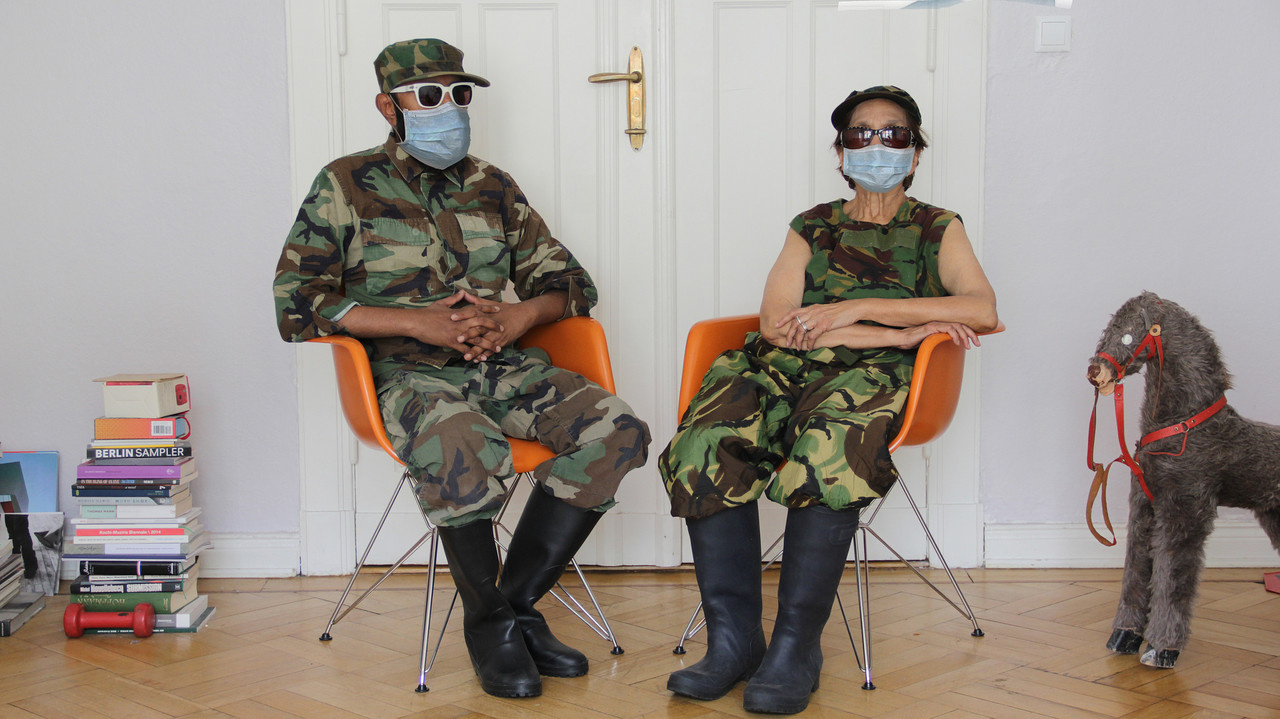
The work attempts to demonstrate the abysmal voids that result from losing common ground in moments of tragedy and flux. A critical view at the extreme polarities we construct, as well as the bastardisation of political correctness into the absurd, the project is a call towards empathy, biodiversity, and a collective consciousness.
Essay by Ibrahim Quraisihi
When we take two different elements from separate fields and put them together, we might find common ground between them. Connecting the different elements can create new possibilities, new meaning, a new essence. But when one element does not accept the other, then no connection or meaning can be formed, and in the worst case, the space between the different elements can become toxic, filled with rejection, resentment, and fear for the unknown, or even with impulses to destroy the other. Beyond affecting the interpersonal realm, animosity between two parties can too easily lead to a collective polarisation and conflict.
Is this separation not what actually happens between groups of people? Between tribes, races, nations? Between natives and foreigners? Between family members, parents, and children? Maybe even between you and me? It happens in that very moment in which we lose curiosity, interest, empathy, and the love for our neighbour, and lose ourselves into the abyss of our own inner psyche.
Losing common ground in moments of tragedy or flux creates voids that often lead to seemingly permanent breaks. These fissures cannot always be easily repaired. The trauma of others elicits a variety of complex responses when it extends onto our own personal fears, which further exasperates an already fragile state of being. Crises often create opportunities to see even more imagined differences, or to imagine divisions of superiority/inferiority, righteousness/immorality, truth/lies in relation to the other.
We construct polarities – our own truths – as a survival mechanism, and to preserve those truths, the other must be set apart, behind a wall, behind bars, behind the borders of a nation-state, in camps, in no-go zones. These mundane polarities become overly codified when a tsunami of unknown realities hits our personal or collective spheres, to a degree that all reasonable contact can break down; what happened and how no longer matters. Illusions, amnesias, and outright fantasies permeate our individual and collective existence only when we forget about the difference between the real and the imagined. It is at this moment that nothing seems right, balanced, or reasonable. We start to live in a bubble of self-constructed fears, gossip, and conspiracies, forgetting that in truth, we are »the Other« in the eyes of the other.
Welcome to »Camels are whispering,« a project inspired by the ideas of indigenous peoples throughout the Middle East, who have resisted fragmentation through contact, and who espouse that whispers (essentially meaning small collective steps) can sustain (bio)diversity. To them, diversity in all its meanings is the only real solution to our collective crisis of consciousness and to environmental catastrophe.
With voice recordings and compositional sound scores by: André Torres Lepecki, Armelle Laborie-Sivan, Amirali Ghasemi, Angela Davis, Assia Djebar, Black Sifichi, Bonaventure Sol bejeng Ndikung, Dan Simon, Diego Agulló, Eleonora Fabião, Eunice Martins, Eyal Sivan, Fawzia Afzal-Khan, Heidrun Schramm, Hanna Schygulla, Heimo Lattner, Hugo Esquinca, Jessika Ekomane, Komi Togbonou, Judith Butler, Marina Abramović, Margarete Mitscherlich, Mike Ladd, Naeem Mohaiemen, Najib Abidi, Nawal Al Saadawi, Noam Chomsky, Norscq, Orhan Pamuk, Paul D. Miller aka DJ Spooky, Pussy Riot, Rubén González Escudero, Sabine Jainski, Seyran Ateş, Sibel Ekidi, Veronique Ruggia-Saura, Yuval Hariri. With Noa Gur interpreting the current discourse of Arab & Israeli female politicians : Aida Touma-Suleiman & Merav Michaeli.
Supported by Stiftung Kunstfonds: Neustart Kultur 2020 & Stiftung Kunstfonds: Arbeitsstipendium 2021.