The lab's first edition was designed as an open toolbox for artists studying their heritage, intended to help them navigate their practice outside of (self-)exoticisation and the uneven power dynamics created by mass-cultural and other stereotypes. Evoking resynthesis—a processing method in computer music that analyzes sounds to extract their fundamental components – as a guiding metaphor, the lab also invites participants to confront conservative views of culture as something frozen, solidified, and generally untouchable, thus resistant to any transformative practices.
By recognising the »traditional« as a dynamic phenomenon and treating it with proper care and respect, the lab aimed to offer a triangular approach to »resynthesis« presenting it as a tool for the aesthetic, technological, and political transformation of cultures and societies. The first two aspects aimed to encourage participants to experiment with various technologies and methods of music and sound production, composition, and performance, reflecting on how this exploratory perspective can unlock the emancipatory potential of sonic practices. The sociopolitical approach aimed to oppose exoticisation, appropriation, tokenism, and the overall colonial gaze, while also inviting participants to consider how their practice can drive political imagination, avoiding the simplification of cultures into stereotypes and acknowledging their complexities and realities.
Carefully addressing the commonly manifested antagonism between the imaginary East and West (or imaginary South and North), this framework was not bound by specific geographical locations but rather by critical methodologies for engaging with the concept of tradition. Within it, reflections on, for example, the highly asymmetrical power relations in what is called »world music« can conceptually coexist with a thorough examination of the increasing connections between folklore and nationalist or essentialist concepts. The lab also focused on the issues of distance and belonging, exploring various artistic and research strategies to engage with tradition for those who are disconnected from their roots due to assimilation, migration, or both.
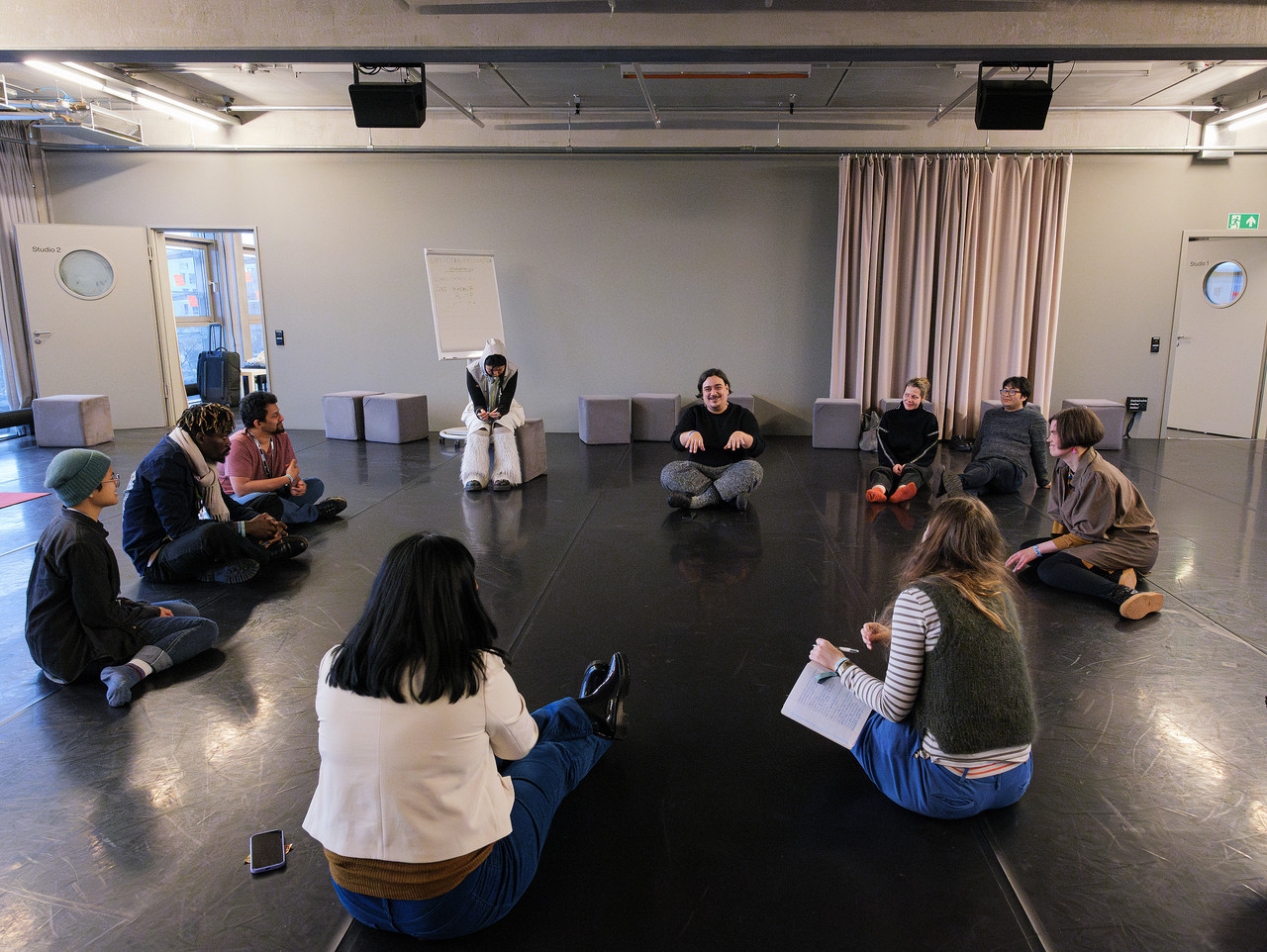
The lab took place in the Radialsystem Studios over the course of six days. Hosting eight fellows selected via open call, it included inputs from other specialists as well as visits to several sites in Berlin. A public finale event took place on Sunday 2 February in Radialsystem Saal.
At CTM 2025, the Resynthesising the Traditional lab was supported by tekhnē, a network initiative that is co-funded by the Creative Europe programme of the European Union. Views and opinions expressed are however those of the author(s) only and do not necessarily reflect those of the European Union or the European Education and Culture Executive Agency (EACEA). Neither the European Union nor EACEA can be held responsible for them.
Medina Bazarğali's participation was supported by Goethe-Institut Kazakhstan.